
PM and IPMA World Congress in Italy
Project Management was born in Italy after the Second World War with the establishment of Engineering Companies, working in the Oil Sector. Let’s mention some of them: Techint (1945), Snam Progetti, now Saipem (1956), Foster Wheeler Italy (1957), Technip Italy (1969), Tecnimont, now Maire Tecnimont (1973). The first experiences of Project Management came through American customers, such as Esso and thanks to the first IBM’s informatics supports. I remember I used the IBM’s Projacs during my first experience of managing an important iron and steel project for the Techint Group, carried out in Argentina between 1967 and 1969. I told about this experience in an article appeared in 1970 and presented at a Conference in Bari, during which it was decided to set up ANIMP: National Association of Industrial Plant Engineering. This Association made itself responsible for the spread of the Project Management culture in Italy.
Since the beginning the Association was marked out for the presence both of the Plant Engineering Companies, that worked prevalently in order to realize turnkey projects, and also of University Professors of the same plant engineering sector. At that time in Italy it didn’t exist at the University a chair for Project Management. The first was established at Politecnico of Milano in 1991 thanks to ANIMP, whereas the first post-graduation Master started in 2000.
ANIMP’s first President was Riccardo Bechis, who lived the positive experience of PM carrying out the same iron and steel plant in Argentina as mentioned above, for which he was the customer’s CEO. Afterwards he undertook to spread the PM culture in the Companies where he worked in the meantime: Italimpianti and ANIMP. Many years passed before ANIMP started international relations. It was thanks to Riccardo Albonetti, PM of SnamProgetti, if they started to look at INTERNET (now IPMA) and had first contacts with Roland W. Gutsch and Steen Lichtenberg. It was with Steen as President, that we organized the first International Symposium in Sorrento, October 18th-20th 1984.
Opening the Conference Steen said: “Progress was always been linked to projects and projects management (PM). Today we more than ever need progress and thus project management to solve our severe problems”. It was very interesting Roland W. Gutsch’s article about PM’s training: “In the light of the rapid development in the fields of technology and administration which is still accelerated by the utilization of electronic media, the demand for a close cooperation across the border can no longer be ignored”. 66 papers were presented. Among the international writers I remember: Hans Knoepfel, Eric Gabriel, Morten Fangel. Among the Italian writers: Maurizio Gatti, Francesco Corbellini, Fulvio Tornic, Vincenzo Lodigiani, Armando Monte, Franco Nobili, Giorgio Orsi, Luigi Iperti and many other prestigious names of the Plant Industry, Manufacturing and Academic World. With this Symposium the Italian PM made an important qualitative leap that took to the organization of the World Congress of 1992 in Florence. I had just finished my four years as ANIMP President, during which I had strongly wanted that Conference, so I was appointed as its chairman and Riccardo Albonetti PM.
Giorgio Orsi was ANIMP President and Morten Fangel was President of Internet, later called IPMA. For the Congress we chose the title: “Project Management without boundaries”. It was the time of the Fall of Berlin Wall, of the European Unification, a period of great expectation and hopes. It was also the anniversary of the 500 years since the discovery of America by Cristoforo Colombo. Florence was a fantastic venue. Martin Barnes, chairman of the Council of Delegates: “obtained enthusiastic appreciation for his fantastic performance in the Project Management play”, as I said at the end of the Congress. Martin presented his show with these words: “I was on the planning committee for the IPMA Congress in 1992 held in Florence. At an early meeting, my colleagues came up with an entirely conventional and rather boring plan for the opening ceremony. I protested and pointed out that Florence, 500 years earlier in 1492, must have been dominated by the project managers of the time who brought about and managed every aspect of the renaissance, the most important political and cultural advance of that millennium. What a project! I persuaded them that we should have a play on this theme as the focal point of the opening ceremony”.
Lorenzo Medici the Magnificent returned among us after 500 years since his death. We had more than 600 participants with 142 papers. It took part also Mary Davon O’ Brien, Chairman of P.M.I. Board. This Congress had important sponsors, coming from the Italian Plant Industry, that was very thriving even if there were some difficulties. Many years later I completely committed myself in order to bring back IPMA to Italy and in 2008, the 22nd IPMA World Congress was held in Rome. I had the great privilege and satisfaction to be chairman, for the second time.
We choose the title: “Project Management to Run”. Opening the Congress I declared: “We all have the need to race against time and Project Management must respond to this need. We want to beat the clock”.
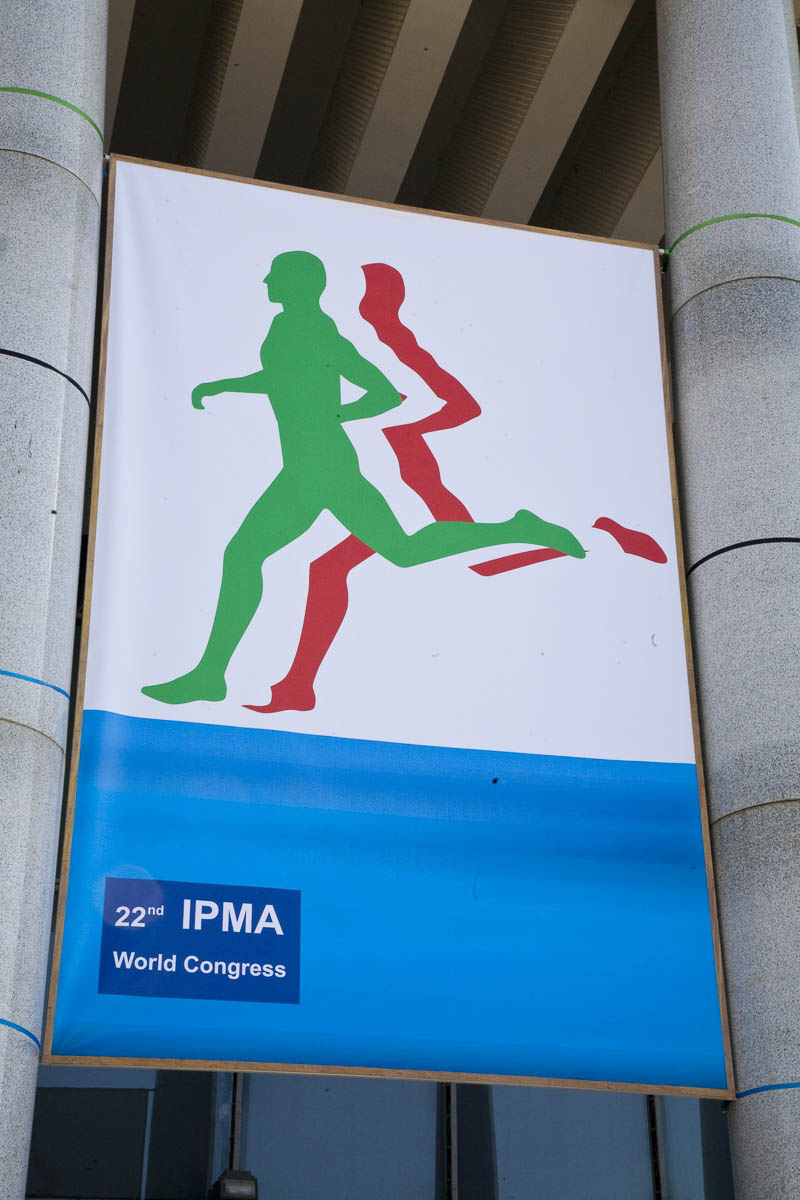
And in the closing I said: “Project management to Run will never come to an end. In the race of life there is no finishing line”. The Congress logo was represented by the stylized figure of a runner and I still remember the thunder of applause when we showed the Congress video, in which athletes running the 100 meters final rush changed into the Congress logo. Among all the people who worked together with me a particular thanks to Roberto Mori, President of the Italian PM Academy and also President of the scientific board and the Project Manager Piermarco Romagnoli. Even this time the Italian Plant Engineering Industry supported us in a deep way. For the venue was chosen Palazzo dei Congressi, with its Imperial architecture. There were presented 250 papers and were represented 40 Countries.
Veikko Valila was IPMA President and Fabrizio Di Amato was ANIMP President. Everyone widely praised the scientific board’s work and in particular Roberto Mori, who shortly after was elected as IPMA Vice President and afterwards President. Veikko said: “The World Congress in Rome was a great success and helped to promote project management as a profession and IPMA as an organization”. Stacy Goff: “Congratulations to Luigi and Roberto for such a magnificent event. Luigi you are especially congratulated for bringing together, guiding and developing such a great team…”. Morten Fangen added: “The opening was definitely the best one with challenging presentations”.
It was impressive the success of the keynote speaker Mr. Toni Ruttimann. He received applause for ten minutes. PMworldtoday wrote: “a project manager of modern times who is sometimes considered a saint. Toni gave an inspirational presentation on how to build 400 bridges without money. With team building and project management. Toni’s life work is to help destitute people build bridges after hurricanes, earthquakes, wars and other disasters”. During the pre-congress activities had a great success the Young Crew Workshop coordinated by Prof. Antonio Calabrese. The Congress had unforgettable occasions, as for example Gala Dinner, presentation of famous operas and the great ball of the last day, in which each Country performed with songs of its own tradition.
In Rome IPMA proved to be not only culture and Project Management, but also a great family with a sprightly friendship attitude.
by Luigi Iperti,
Vice President TECHINT INDUSTRIAL CORPORATION SPA

Sandra currently works as Assistant to the IPMA President and Executive Director. Since joining IPMA in 2012, Sandra worked in FMCG sector for Procter&Gamble. She holds Master in Economics from Faculty of Economics and Business, University of Zagreb. After graduation she continued at the same University the doctoral programme in Business Economics. Her particular research interest is behavioral economics.
Topics of interest
Most Read
-
 15 June 2018 | 7:26
5Ws 1H: A technique to improve Project Management Efficiencies
-
 29 January 2018 | 8:13
5S (or 6S) Lean Management technique: Possible uses in project management
-
 02 February 2018 | 2:32