
Getting The Right People On The Bus: The ICB4 Dream Team
This is the story of how one small team created a big work product. And about how getting the right people on the bus is often more important than knowing your direction from the beginning.
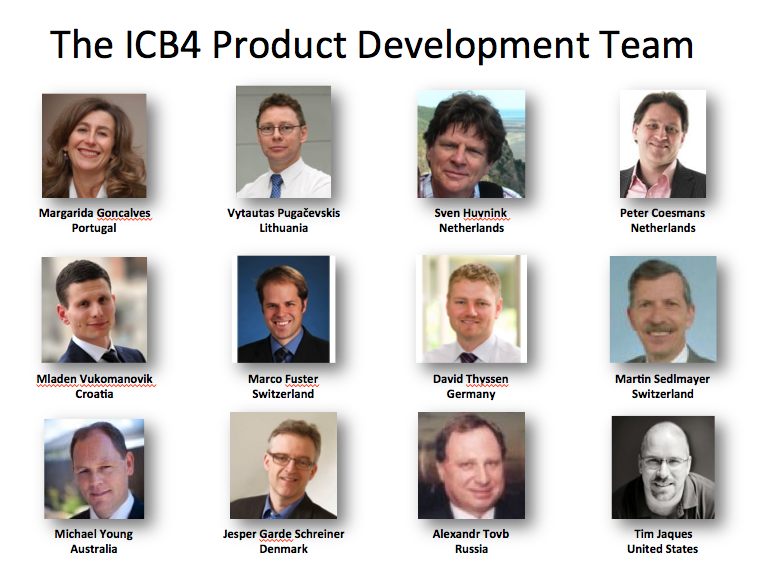
When the twelve editorial staff were assigned to the project in September 2013, the project was in disarray. We had been through 1.5 years of discussions with a much larger group of up to 150 subject matter experts. Many of these original contributors felt that their efforts were in vain because the project was not delivering a work product. ExBo reformulated the project to include a small team of hand picked individuals, each with strong resume. This new team took a different approach. Instead of seeing the ICB4 as a certification tool, we established that the ICB4 was something larger – a global standard that could be used by many different types of users from assessors to HR, to trainers and educators, to the individual PM. Therefore, we established this document as a product, with a product development lifecycle.
What Was Our Process?
- Content Development. This workgroup wrote and edited the core content, and synced content across different products and sections of the ICB4.
- Marketing/Product Development. This team created transformed the raw content into the product – including key tasks like layout and design. This team drove development of the structure, web pages and collateral content.
- Stakeholder Engagement. This team focused on working with the public and with key stakeholders via surveys, conversations, and focus groups. We test the content several times to ensure that it was aligned with stakeholder expectations.
- Team Support. This included the project manager, project secretary and others across IPMA and the MAs who supported our efforts.
By adopting a workgroup approach within the team, we were able to focus on specific areas of the growing body of content without slowing down the whole group.
- Develop teams who listen, understand and compromise. We spent time discussing our own performance. This helped us to become better team members. When someone was stuck in a way of thinking, invariably, the team would find a way to help that person break through, or even the other way around. We had many long discussions and battles over content in ICB4. But always, there was a sense of fair play and “let the best ideas win.”
- Faster, shorter delivery cycles is almost always better. We found that long assignments suck out the energy and lose the accountability. Instead, we recommend shorter cycles and clear assignments.
- Get to know your customers. The ICB4 team spent time working with MA’s, industry, and assessors to name a few. We met privately and in larger focus group settings. We really tried to keep an external focus throughout and not get stuck inside our own belief sets.
- Build diverse teams. One strength of IPMA is its diverse membership. ICB4 excelled at diversity in terms of expertise, however we could have used more diversity in race, gender. As a federation, IPMA needs to spend more focus on building teams that reflect our federation geographically and in terms of race, gender, and background.
- Minimize logistics and friction. Global teams need strong support. We set up file sharing, regular dial in numbers, common processes in order to minimize the friction and keep people focused on the most important parts of development.
Delivery In 2015
After more than 4 years since the project’s inception, and thousands of hours of effort, the new ICB4 Global Standard was delivered at the 2015 World Congress.

For more than twenty years, Tim Jaques has been exploring, thinking, speaking, and writing on the topics of project management, organizational change, culture, and human performance. Tim is an avid writer, presenter, and facilitator. As the IPMA Global Director for Special Interest Group (SIG), Tim supports the IPMA vision of promoting competence throughout society to enable a world in which all projects succeed. Tim’s work in IPMA focuses on connecting global experts to solve some of the world’s most important and complex challenges through the development of special interest groups around topics as diverse as Innovation, Smart Cities, Smart Rural, Artificial Intelligence and Mega Projects to name a few.
In business, Tim’s work today focuses on business transformation and workplace performance through his company Teaming Worldwide. Tim has worked with a variety of private and public sector clients including General Electric, Toshiba, Tufts University, the US Army, US Postal Service. Teaming Worldwide delivers professional development and performance consulting, re-imagined using the latest science in adult learning, motivation and performance.
Tim’s core capabilities include project and program management, performance improvement, execution and operations, organizational change management, IT transformation, and business strategy. Tim co-authored the International Project Management Association (IPMA) Individual Competence Baseline, version 4, an international project, program and portfolio competence standard. He has published two books on US Federal government PM practices; and written numerous articles on project management, organizational change and transformation.
Tim is a past vice-president of IPMA-USA and has held numerous board positions.
Topics of interest
Most Read
-
 15 June 2018 | 7:26
5Ws 1H: A technique to improve Project Management Efficiencies
-
 29 January 2018 | 8:13
5S (or 6S) Lean Management technique: Possible uses in project management
-
 02 February 2018 | 2:32